

Lentiviral Gene Expression & Overexpression Library
abm offers a comprehensive collection of human, mouse and rat genes cloned into expression-ready lentiviral vectors or supplied as packaged recombinant lentivirus for gene over-expression studies. Lentiviral delivery is commonly used when stable genomic integration, long-term expression, or efficient delivery into difficult-to-transfect mammalian cells is required.
On this page: How Lentivirus Works | Vector Design | Promoters & Markers | Packaging Systems | Packaging Service | Related Products | Data | Resources
Search our Ready-to-Use Libraries: select the dropdowns and enter gene name, symbol or accession number
Why Lentiviral Vectors Are Used for Stable Gene Overexpression
Lentiviral vectors are engineered from lentiviruses, a type of retrovirus whose RNA genome is reverse-transcribed into DNA after entering a target cell. The resulting vector DNA can integrate into the host genome, allowing the delivered expression cassette to be maintained as cells divide. In laboratory lentiviral systems, the transfer vector carries the gene of interest and the sequences required for delivery, while the viral proteins needed to produce lentiviral particles are supplied separately during packaging. This separation enables stable gene delivery without placing the complete viral genome required for replication into the transfer vector.
Stable integration makes lentiviral vectors particularly useful for long-term gene overexpression, where expression must persist through multiple cell divisions rather than decline as transiently transfected plasmid DNA is diluted. Lentiviral vectors can transduce both dividing and non-dividing cells and have an overall packaging capacity of approximately 9 kb between the LTRs. This capacity includes the complete sequence packaged in the transfer vector, not only the gene of interest; as vector size increases, packaging efficiency and viral titer may decrease. These properties make lentivirus a versatile option for gene-function studies across a broad range of mammalian cell models.
Common applications include:
- Stable cell line or population generation — maintain expression of a gene of interest through continued culture and cell division.
- Gain-of-function and pathway studies — increase expression of a candidate gene to investigate its biological function and downstream effects.
- Target validation and phenotypic screening — examine how sustained gene expression alters cellular phenotype or experimental readouts.
- Difficult-to-transfect or non-dividing models — deliver genes into cell types where conventional plasmid transfection may be inefficient.
For additional background on lentiviral vector biology and experimental design, visit our Lentivirus System Introduction.
Third-Generation Lentiviral Transfer Vector Design
abm's lentiviral expression/transfer vectors use a third-generation, Tat-independent lentiviral design. A chimeric RSV promoter is positioned upstream of the 5′ LTR to drive production of vector RNA during packaging, while an internal mammalian promoter drives expression of the gene of interest after transduction.
| Vector Feature | What It Does | Why It Matters Experimentally |
|---|---|---|
| Third-generation transfer vector | Separates the gene-delivery cassette from viral packaging functions. | The transfer vector itself does not encode the full set of viral proteins required for replication. |
| Chimeric RSV / 5′ LTR | Supports transcription of the transfer-vector RNA during packaging. | Allows the expression vector to be Tat-independent. |
| Internal expression promoter | Drives transcription of the ORF/cDNA in the transduced target cell. | Promoter choice can be matched to the desired cell model and expression profile. |
| Kozak sequence | Supports efficient translation initiation around the start codon. | Helps support expression of mammalian protein-coding ORFs. |
| WPRE | Post-transcriptional regulatory element positioned upstream of the 3′ LTR. | Supports efficient transgene expression. |
| Reporter / selection cassette | Provides fluorescent tracking and/or antibiotic resistance. | Enables identification, enrichment or selection of successfully transduced cells. |
Promoters, Reporters & Selection Markers
Lentiviral overexpression is not a one-vector-fits-all system. The promoter determines how the ORF is transcribed, while reporter and antibiotic-resistance cassettes determine how transduced cells can be identified or selected.
Common Promoter Options
Promoter selection can influence both the level and persistence of transgene expression. abm lentiviral vectors are available with several commonly used constitutive promoters; the best choice depends on the target cell type, desired expression level and overall vector design.
| Promoter | Typical Expression Profile | When to Consider It |
|---|---|---|
| CMV | Strong constitutive expression in many mammalian cell types. | The standard promoter in many abm genome-wide lentiviral expression constructs and a good starting choice when robust expression is desired. |
| EF1α | Broad constitutive expression commonly used for sustained expression. | A useful alternative when CMV-driven expression is weak, variable or decreases during longer-term culture in the experimental model. |
| PGK | Compact promoter that generally provides more moderate constitutive expression than CMV. | Useful when very high expression is not required or when conserving vector space is important for a larger expression cassette. |
| UbC | Constitutive promoter commonly used for steady, moderate transgene expression. | Consider when a more moderate expression profile is preferred over very strong CMV-driven expression. |
Common Reporter & Selection Configurations
| Configuration | Typical Use |
|---|---|
| CBh-GFP-2A-Puro | Fluorescent tracking plus puromycin selection from a linked reporter/selection cassette. |
| CBh-RFP-2A-Puro | Red fluorescent tracking plus puromycin selection. |
| SV40-Puro | Puromycin selection without a fluorescent reporter. |
| SV40-Neo | Neomycin/G418 selection. |
| SV40-Hygro | Hygromycin selection. |
| SV40-Blast | Blasticidin selection. |
pLenti-III-CMV-Blank-CBh-GFP-2A-Puro
This blank control illustrates a commonly used architecture: a CMV-driven gene-expression cassette paired with a separate CBh-GFP-2A-Puro reporter/selection cassette. In a gene-expression construct, the blank region is replaced by the selected ORF/cDNA.
2nd vs. 3rd Generation Lentivirus Packaging
The generation of the transfer vector and the generation of the packaging system are related but are not the same thing. abm's expression/transfer vectors are third-generation and Tat-independent, but they can be packaged using either the 2nd Generation Lentivirus Packaging Mix (LV003) or 3rd Generation Lentivirus Packaging Mix (LV053).
| Packaging System | Plasmids Required | System Design | When to Consider It |
|---|---|---|---|
| LV003 — 2nd Generation Packaging Mix | 3 plasmids | Transfer plasmid + packaging plasmid + VSV-G envelope plasmid | Requires fewer plasmids to be co-transfected and is commonly selected when robust virus production is the priority. |
| LV053 — 3rd Generation Packaging Mix | 4 plasmids | Transfer plasmid + Gag/Pol + Rev + VSV-G envelope plasmid | Separates viral packaging functions across additional plasmids for a higher degree of packaging-system separation. |
What Is Required for 3rd Generation Packaging?

HEK293T cells are commonly used for lentivirus production because of their high transfection efficiency. Final viral yield depends on the transfer vector, insert size and sequence, cell health and production conditions. For the lentivirus packaging workflow, see A Guide to Lentivirus Production (Protocol, Tips, & more!).
Explore abm's Virus Packaging Service
Prefer to start directly with packaged virus? Choose a lentivirus packaging scale based on your application, purification requirement and target titer.
| Scale | Application | Purification | Typical Titer | Volume | Price |
|---|---|---|---|---|---|
| Mini | Cell culture | Supernatant | 108 IU/ml | 3 x 250 μl | $189.00 |
| Regular | Cell culture | Gradient | 109 IU/ml | 4 x 100 μl | $479.00 |
| Ultra-Pure | In vivo | Ultracentrifuge | 1010 IU/ml | 10 x 50 μl | $1,199.00 |
How Should MOI Be Selected?
MOI describes the number of infectious lentiviral units applied per cell. Increasing MOI generally increases the probability of transduction, but the required MOI varies substantially by cell type — from as low as 1 for harder-to-transduce lines like MDA-MB-231 up to 20 for PC12 cells. The table below lists suggested starting MOIs for 22 commonly used cell lines; treat these as a validated starting point and still test a small range around the suggested value for any new model.
| Cell Line | Description | Suggested MOI |
|---|---|---|
| A431 | Human Epidermal Carcinoma | 5 |
| A549 | Human Lung Carcinoma | 5 |
| B-16F10 | Mouse Skin Melanoma, Metastatic | 5 |
| BxPC3 | Human Pancreatic Adenocarcinoma | 10 |
| H3255 | Human Non-small Cell Lung Cancer | 10 |
| HCT116 | Human Colon Carcinoma | 5 |
| HeLa | Human Cervical Carcinoma | 3 |
| Hepa6-1 | Mouse Liver Carcinoma | 3 |
| HT29 | Human Colon Adenocarcinoma | 3 |
| Jurkat | Human Acute T Cell Leukemia | 10 |
| LLC1 | Mouse Lung Carcinoma | 6 |
| LNCaP | Human Prostate Carcinoma | 5 |
| MM200 | Human Skin Melanoma | 5 |
| MCF7 | Human Breast Adenocarcinoma | 2 |
| MDA-MB-231 | Human Breast Adenocarcinoma | 1 |
| MM-AN | Human Skin Melanoma, Metastatic | 16 |
| MMC | Mouse Breast Carcinoma | 4 |
| MRC5 | Human Embryonic Lung Fibroblasts | 1 |
| NB4 | Human Acute Promyelocytic Leukemia | 10 |
| PC12 | Rat Adrenal Gland Pheochromocytoma | 20 |
| SKOV3 | Human Ovary Adenocarcinoma | 15 |
| U2-OS | Human Bone Osteosarcoma | 5 |
A downloadable version of this table is also available: Suggested MOI for Common Cancer Cell Lines (PDF). See abm's full MOI methodology and guide for additional cell lines and background on calculating MOI.
Lentiviral Gene Overexpression Data
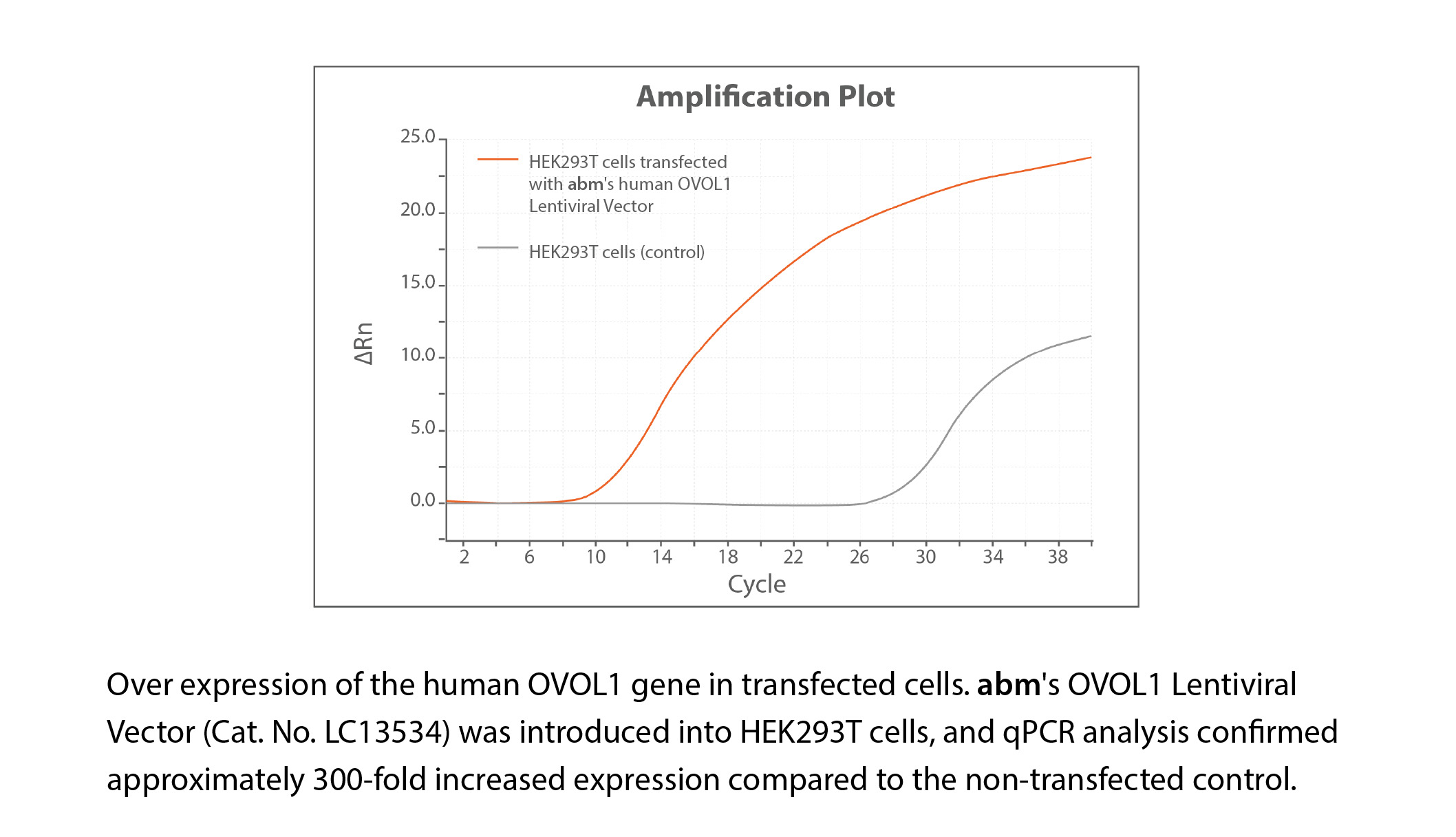
Achieve Up To 300-Fold OVOL1 Over-Expression
qPCR analysis following delivery of abm's OVOL1 Lentiviral Vector showed up to approximately 300-fold increased OVOL1 expression under the tested experimental conditions.
This illustrates the intended use of the expression library: select a gene, deliver the expression cassette, and evaluate the resulting molecular or phenotypic response.

Lentivirus Protocols & Resources


Lentivirus Introduction
Learn more about lentiviral vector biology, delivery and experimental considerations in our Learning Resources.
Top Publications
| 01 | Histone demethylase KDM5D upregulation drives sex differences in colon cancer. Li J. et al. Nature (2023) doi: 10.1038/s41586-023-06254-7 |
| 02 | Matrix mechanics and water permeation regulate extracellular vesicle transport. Lenzini S. et al. Nature Nanotechnology (2020) doi: 10.1038/s41565-020-0636-2 |
| 03 | Age-related Huntington’s disease progression modeled in directly reprogrammed patient-derived striatal neurons highlights impaired autophagy. Oh YM. et al. Nature Neuroscience (2022) doi: 10.1038/s41593-022-01185-4 |
FAQs
| Can I customize the promoter, reporter or selection marker? |
| Can I use my own packaging plasmids with an abm lentivector? |
| Can I place a polyadenylation signal inside the lentiviral insert? |
| How are abm lentiviral plasmids supplied? |
| Why use lentiviral expression vectors for gene studies? |
| What cell types can be transduced with lentiviral cDNA expression vectors? |
• Primary cells (e.g., neurons, T cells)
• Stem cells
• Hard-to-transfect lines (e.g., suspension cells, hematopoietic cells)
This broad tropism makes them highly versatile for research and therapeutic applications.
| Can I use lentiviral ORF clones for high-throughput screening? |
Need a Custom Lentiviral Design?
Build a custom lentiviral vector or contact abm's technical team for help with promoter selection, expression-cassette design, tags, reporters, selection markers and packaging.