

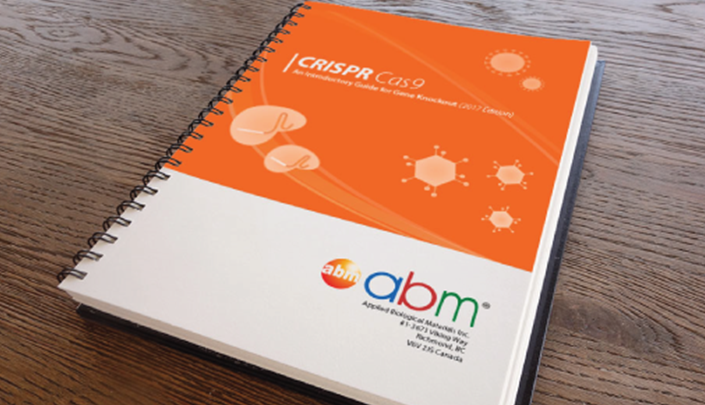
Cell Immortalization Handbook
This Handbook provides an overview of methods, protocols, and reagents.
Immortalized cells provide unlimited, consistent access to the same cell line, helping reduce batch-to-batch variability and the high costs associated with primary cell use.
As a pioneer in cell immortalization technology, abm offers a comprehensive selection of immortalization viruses, 600+ immortalized cell lines developed across human and multiple animal species, published protocols and technical guides, and cell immortalization services with QC and validation.

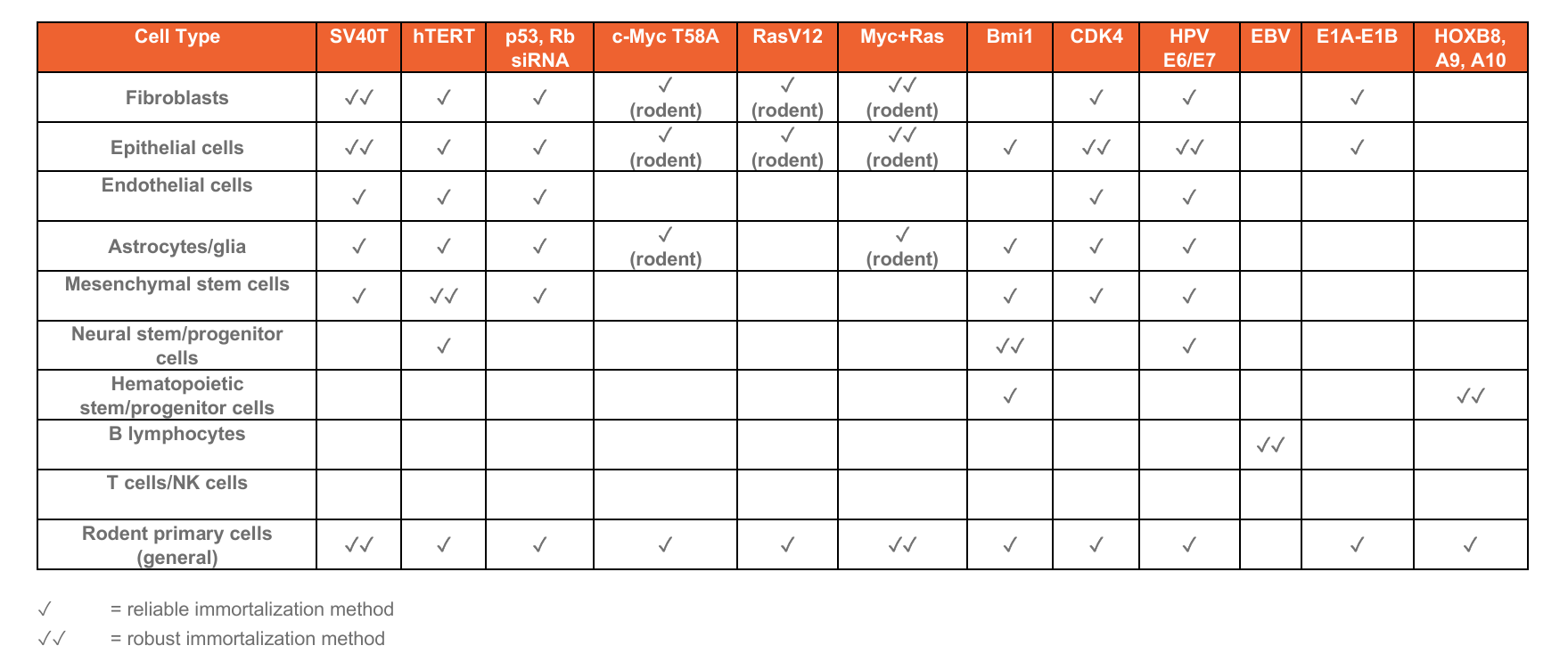
Select the cell type closest to your model to see recommended immortalization methods and jump directly to relevant products.
Recommended: SV40T or CDK4 + hTERT.
High success rate →Recommended: CDK4 + hTERT or HPV E6/E7.
Better phenotype retention →Recommended: hTERT.
Less transformation →Recommended: Bmi1.
Maintains progenitor state →Recommended: EBV.
Standard approach →Use this at-a-glance matrix before comparing individual recombinant viruses and validation bundles.
| Cell type | Recommended method | Notes |
|---|---|---|
| Fibroblasts | High success rate | |
| Epithelial cells | Better phenotype retention | |
| Endothelial cells |
hTERT
|
Less transformation |
| Neural stem cells |
Bmi1
|
Maintains progenitor state |
| B cells |
EBV
|
Standard approach |
SV40 large T antigen is a gold-standard for efficiently immortalizing primary mammalian cells. It enables continuous proliferation through multiple mechanisms:
Whether you're developing epithelial, kidney, or respiratory models, SV40 T antigen ensures robust performance and reliable expansion.
Choose a matched SV40T immortalization virus plus Anti-SV40T antibody for convenient post-transduction validation.
| Product Name | Cat. No. | Vector Map | Promoter | Marker | Price |
|---|---|---|---|---|---|
| Lentivirus | |||||
Lenti-SV40T (Puro) Virus  |
LV613 | View | CMV | Puro | Inquire |
| Lenti-SV40T (Neo) Virus | LV660 | View | CMV | Neo | Inquire |
| Lenti-SV40T Virus | LV665 | View | CMV | Inquire | |
| Lenti-SV40Tt Virus | LV614 | View | CMV | Puro | Inquire |
| Lenti-SV40 Virus | LV612 | View | SV40 | Inquire | |
| Lenti-SV40T (tsA58 temp sensitive) (Puro) Virus |
LV630 | View | CMV | Puro | Inquire |
| Lenti-SV40T (tsA58 temp sensitive) Virus | LV680 | View |
CMV | Inquire | |
| Adenovirus | |||||
| Adeno-SV40T Virus | G210 | View | CMV | Puro | Inquire |
| Retrovirus | |||||
| Retro-SV40 Virus | G212 | View | 5'LTR | Neo | Inquire |
| Retro-SV40LT Virus | RVP010 | View | CMV | Puro | Inquire |
When native cell function matters, hTERT is the preferred choice. Unlike oncogenic methods, hTERT gently extends cellular lifespan by reactivating telomerase, the enzyme that maintains telomere integrity.
Key Benefits:
Perfect for immortalizing fibroblasts, epithelial cells, or stem-like populations while retaining physiological relevance.
| Product Name | Cat. No. | Vector Map | Promoter | Marker | Price |
|---|---|---|---|---|---|
| Lentivirus | |||||
| Lenti-hTERT-Puro Virus |
LV615 | View | CMV | Puro | Inquire |
| Lenti-hTERT-Neo Virus | LV622 | View | CMV | Neo | Inquire |
| Lenti-hTERT Virus | LV674 | View | CMV | Inquire | |
| Lenti-hTERT-2A-CDK4 Virus |
LV677 | View | CMV | Puro | Inquire |
| Lenti-EF1a-hTERT Virus | LV616 | View | EF1a | Puro | Inquire |
| Lenti-EF1a-hTERT-Hygro Virus | LV632 | View | EF1a | Hygro | Inquire |
| Adenovirus | |||||
| Adeno-hTERT Virus | G205 | View | CMV | Inquire | |
| Adeno-hTERT Antisense Virus | G208 | View | CMV | Inquire | |
Explore HPV E6/E7, EBV genes, E1A-E1B, siRNA, Bmi1, CDK4, Myc T58A, Ras V12, HOXB8, HOXA9, HOXA10, and related transduction reagents.
| Product Name | Cat. No. | Vector Map | Application | Price |
|---|---|---|---|---|
| HPV E6/E7 | ||||
| Lenti-HPV E6/E7 (Puro) Virus |
LV617 | View | Immortalize keratinocytes | Inquire |
| Lenti-HPV E6/E7 Virus | LV667 | View | Inquire | |
| EBV genes (Epstein-Barr Virus) | ||||
| EBV Virus | G229 | N/A | Immortalize B lymphocytes, and sometimes T lymphocytes | Inquire |
| E1A-E1B | ||||
| E1A-E1B Lentivirus | LV652 | View | Immortalize a wide range of primary rodent cells, including amniotic fluid cells, epithelial cells, fibroblasts, and kidney cells | Inquire |
| siRNA | ||||
| Lenti-Rb siRNA Virus | LV621 | View | Co-express with hTERT for better immortalization of epithelial cells | Inquire |
| Lenti-p53 siRNA Virus | LV619 | View | Inquire | |
| Bmi1 | ||||
| Lenti-Bmi1 Virus | LV608 | View | Immortalize epithelial cells | Inquire |
| CDK4 | ||||
| Lenti-hTERT-2A-CDK4 Virus |
LV677 | View | Co-express with hTERT for a more authentic cell model | Inquire |
| Lenti-CDK4 Virus | LV609 | View | Inquire | |
| Lenti-CDK4(R24C)-CCND1-BMI1 Virus, High Titer | LV681 | View | Inquire | |
| Lenti-CDK4(R24C) Virus, High Titer | LV682 | View | Inquire | |
| Myc T58A (c-Myc), Ras V12 (H-Ras) | ||||
| Lenti-Myc T58A Virus | LV618 | View | Immortalizes a wide variety of cells, including neural stem cells, primary kidney cells, erythroblasts, and a variety of epithelial cells | Inquire |
| Lenti-Ras V12 Virus | LV620 | View | Inquire | |
| HOXB8, HOXA9, HOXA10 | ||||
| Lenti-HOXB8-C-HA Virus | LV636 | View | Immortalize hematopoietic cells, including macrophages, hematopoetic progenitor cells, and myeloid progenitor cells | Inquire |
| Lenti-HOXA9-C-HA Virus | LV642 | View | Inquire | |
| Lenti-HOXA10-C-HA Virus | LV645 | View | Inquire | |
| Other Related Reagents | ||||
| ViralEntry™ Transduction Enhancer (100X) | G515 | Boosts lentiviral transduction | Inquire | |
abm offers cell immortalization services with QC and validation. Our scientists can immortalize your cell line of choice.
If you would rather start with a ready-to-use cell line or have the immortalization performed for you, use the service page below.
Explore our Cell Immortalization Service for project details and inquiry options.
See how cell immortalization reagents from abm have been used in published research. Expand each example for study details and citations.
Use the chart to compare reagent compatibility across cell types.
Access protocols, workflow guidance, service support, and downloadable technical documents.
This Handbook provides an overview of methods, protocols, and reagents.
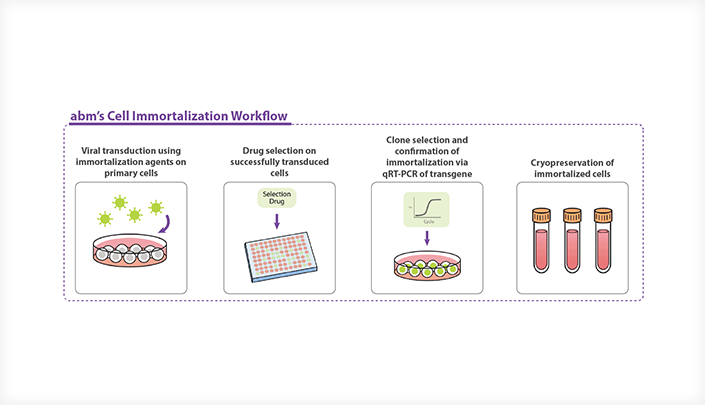
For more information, visit our Cell Immortalization Learning Resource.
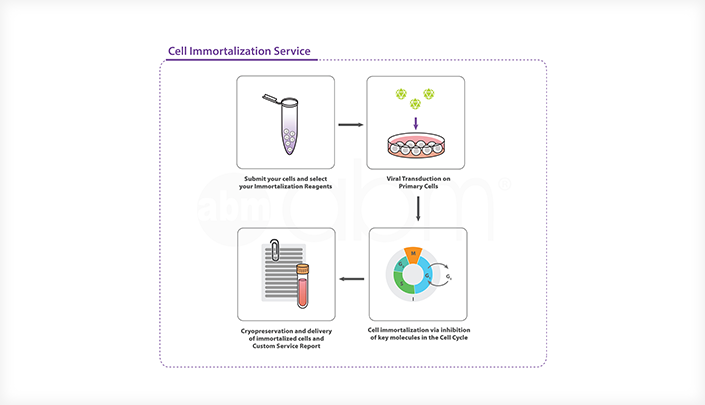
Our scientists can immortalize your cell line of choice.
Explore selected peer-reviewed publications featuring cell immortalization applications.
Establishment and characterization of imortalized sweat gland myoepithelial cells.
Hayakawa T. et al. — Scientific Reports (2022)
doi: 10.1038/s41598-021-03991-5
Integrative analyses of human reprogramming reveal dynamic nature of induced pluripotency.
Cacchiarelli D. et al. — Cell (2015)
doi: 10.1016/j.cell.2015.06.016
Tumor-penetrating therapy for β5 integrin-rich pancreas cancer.
Hurtado T. et al. — Nature Communications (2021)
doi: 10.1038/s41467-021-21858-1
Direct answers to common questions about methods, cell types, phenotype, validation, and long-term culture.