

Experimental Data
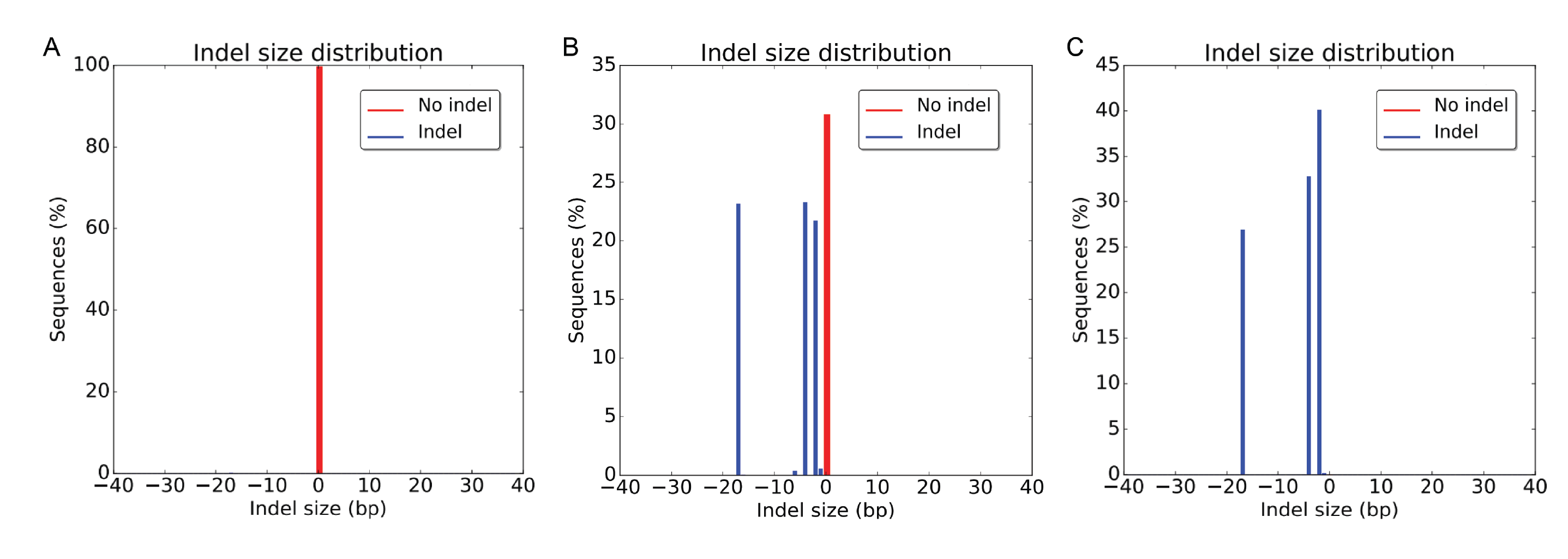
CRISPR Knockout Performance & Data
Review experimental examples and supporting data to help plan and evaluate a CRISPR knockout workflow.
View Case Study →Search gene-specific CRISPR knockout products for human, mouse, and rat targets. Choose from All-in-One Cas9 + sgRNA systems or sgRNA-only vectors in lentiviral, AAV, and non-viral formats. Cas9-directed double-strand breaks can be repaired through non-homologous end joining (NHEJ), generating indels that may produce deleterious frameshift mutations.
Choose a CRISPR delivery system based on your experimental needs, then search by gene symbol, gene name, or accession number to find available knockout vectors and viruses.
The system selected above is automatically applied to the search below.
Compare All-in-One lentiviral, AAV, and non-viral options in more detail after choosing the delivery format that best fits your experiment.
Each system below expresses Cas9 and a gene-specific sgRNA from the same construct.
| Feature | Lentiviral | AAV | Non-Viral |
|---|---|---|---|
| Typical construct | spCas9 + sgRNA + PuromycinR | saCas9 + sgRNA | spCas9 + sgRNA + GFP |
| Best suited for | Stable knockout workflows and many difficult-to-transfect cells | Selected in vivo, tissue-directed, and primary-cell applications | Transfection-compatible cultured cells and small-scale studies |
| Expression profile | Stable genomic integration and long-term expression | Primarily episomal expression with limited cargo capacity | Plasmid-based expression without viral production |
| Key consideration | Suitable for many dividing and non-dividing cells | Uses the smaller saCas9 nuclease to fit within AAV cargo limits | Requires efficient plasmid transfection |
| Available formats | Vector DNA or packaged lentivirus | Vector DNA or packaged AAV | Plasmid DNA |
| Scrambled controls | |||
| Browse backbones | View Lentiviral Backbones | View AAV Backbones | View Non-Viral Backbones |
Choose an sgRNA-only vector when your cells already express a compatible Cas9 nuclease, or when Cas9 and the sgRNA will be delivered separately. Gene-specific products open with a recommended All-in-One backbone, but you can switch to an sgRNA-only configuration using the Customize Vector option on the product page.
Move from target selection to a validated knockout with a straightforward experimental workflow.
Select a gene-specific sgRNA for your species and target gene.
Use lentiviral, AAV, or non-viral delivery based on your experimental system.
Enrich transduced or transfected cells using the reporter or selection marker included in the selected system.
Screen the targeted genomic region for CRISPR-induced sequence changes before downstream validation.
Confirm the genomic edit and verify loss of the expected gene or protein function using an appropriate downstream assay.
Practical guides, experimental data, verification tools, and learning resources for planning, running, and validating CRISPR knockout experiments.
Review experimental examples and supporting data to help plan and evaluate a CRISPR knockout workflow.
View Case Study →
Review sgRNA design guidance, knockout strategies, experimental procedures, and practical troubleshooting tips.
Open Guide →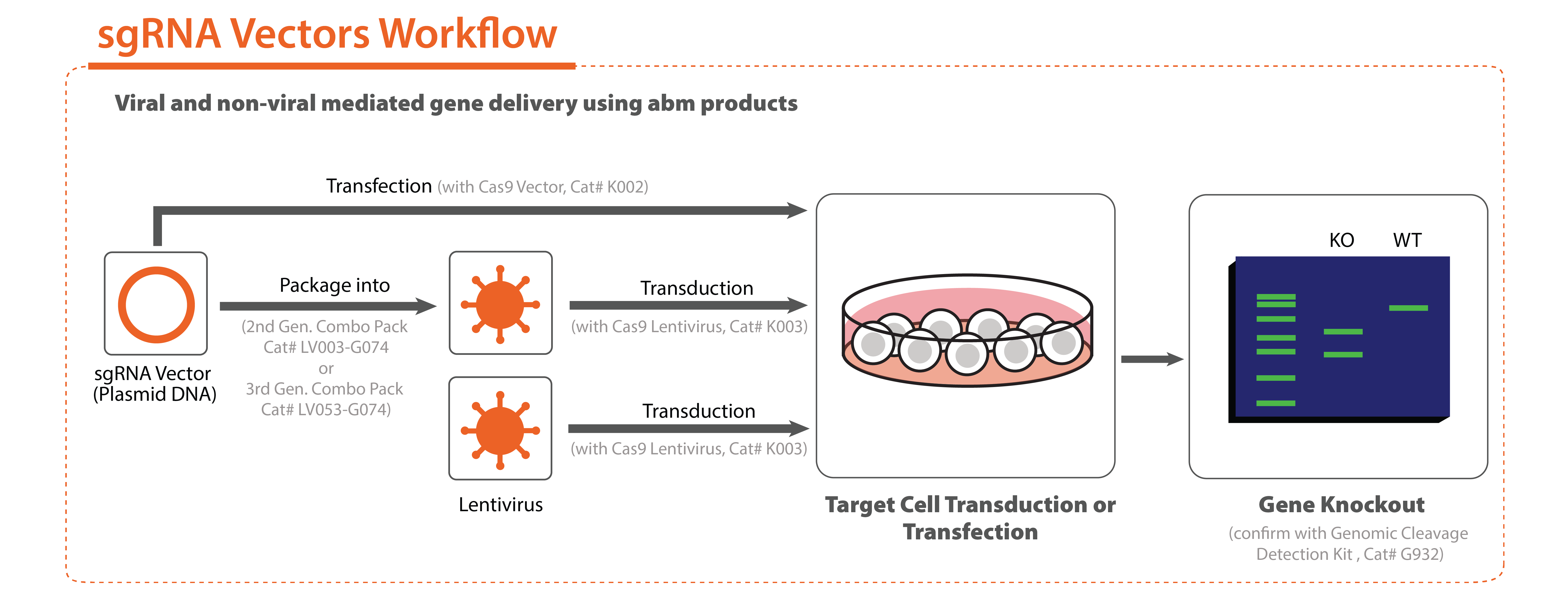
Follow the major experimental steps from lentiviral delivery and selection through editing verification and knockout validation.
View Workflow →
Use the G932 Cleavage Detection Kit to confirm CRISPR editing in mixed cell populations in 4 hours, or use G990 Screen It™ to identify wild-type, monoallelic, and biallelic clones.

Watch a step-by-step CRISPR knockout experiment covering lentiviral delivery, selection, clone isolation, and editing validation.
Watch Video →
Browse articles, protocols, videos, case studies, and practical guides covering CRISPR design, delivery, screening, and validation.
Explore Learning Resources →Download product guides, technical materials, and supporting protocols for CRISPR knockout experiments.
Selected peer-reviewed studies highlighting applications of abm CRISPR products in published research.
Additional CRISPR-related publications are available throughout the abm product catalogue and technical literature.
Common questions about CRISPR knockout vectors, delivery systems, controls, and experimental selection.
CRISPR KO (knockout) vectors are genetic tools designed to deliver Cas9 nuclease and guide RNA (sgRNA) into cells to create gene knockouts via double-strand breaks and non-homologous end joining (NHEJ). These vectors can be packaged into lentiviruses, AAVs, or used as plasmids for transient transfection.
Lentiviral CRISPR KO vectors are ideal when:
Yes. AAV CRISPR KO vectors are preferred for:
However, due to AAV’s small packaging capacity, researchers often use dual-vector systems (one for Cas9, one for sgRNA; or saCas9).
Non-viral methods include:
These are ideal for rapid, transient knockouts with minimal genomic integration risk.
The choice depends on cell type, duration of expression, and safety requirements.
Lentiviral CRISPR KO viruses efficiently transduce:
Their broad tropism makes them popular for genome-wide CRISPR knockout screening.
Yes. We offer custom pooled CRISPR KO libraries in lentiviral format for genome-wide functional screening.
Because lentiviral CRISPR KO vectors integrate into the genome, Cas9 and sgRNA are stably expressed, making the knockout permanent in most cases, provided the target gene undergoes successful NHEJ-induced frameshift mutations.
Tell us your target gene, species, cell type, and preferred delivery format. Our technical team can help identify a premade product or discuss a custom sgRNA vector or virus.