

CRISPR Activation & Repression
Modulate endogenous gene expression without introducing DNA double-strand breaks. Use dCas9-VPR for transcriptional activation, dCas9-KRAB for transcriptional repression, or epigenetic dCas9 effectors for targeted DNA demethylation or methylation.
Activate Gene Expression with dCas9-VPR
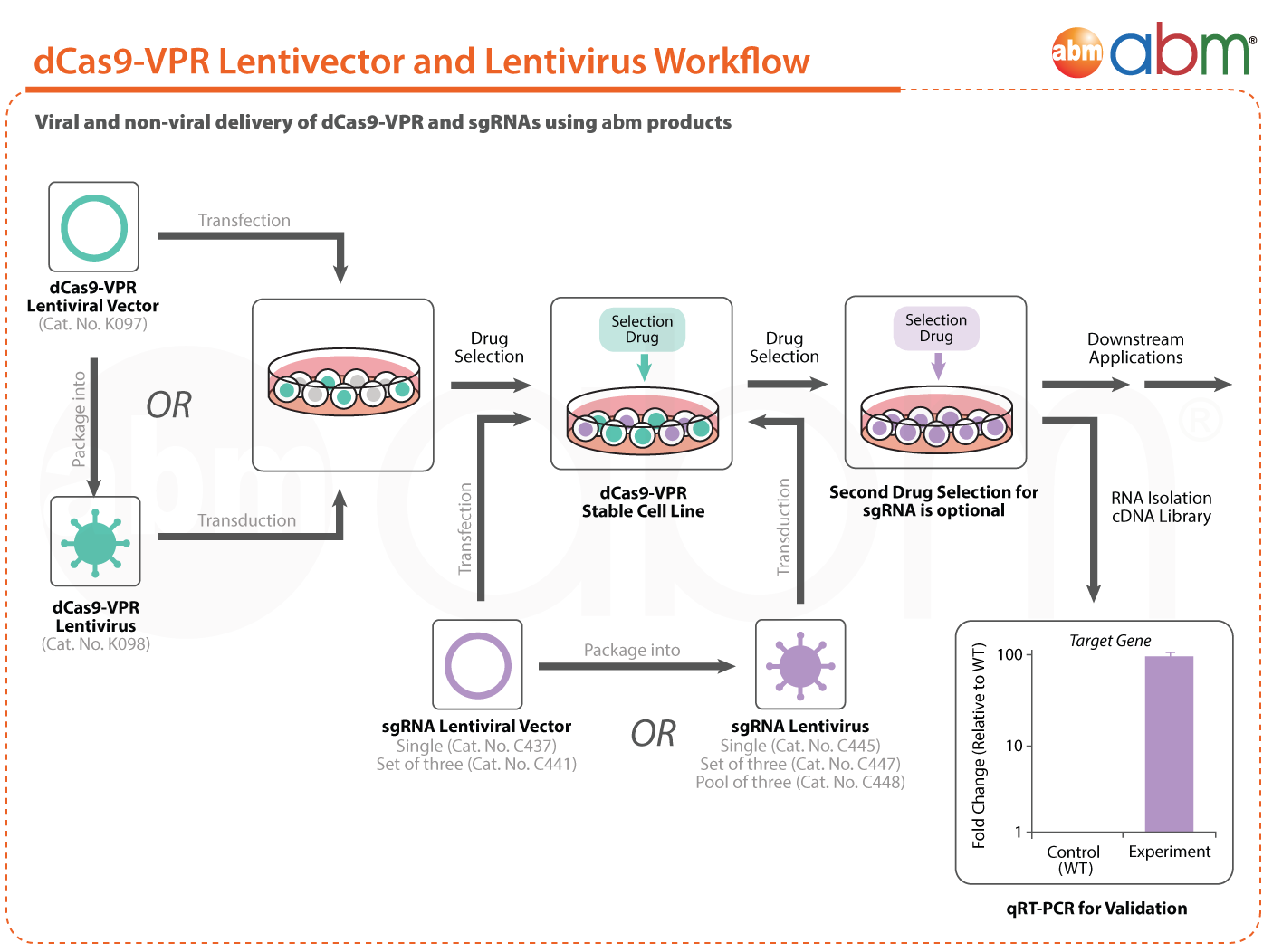
dCas9-VPR combines catalytically inactive Cas9 with the VP64, p65 and Rta transcriptional activator domains. A promoter-targeting sgRNA directs the complex near the transcriptional start site (TSS), where VPR recruits transcriptional machinery to increase expression from the endogenous gene locus.

- Activates the endogenous gene rather than expressing a separate ORF
- No DNA double-strand break
- Useful for gain-of-function studies, pathway activation and functional genomics
- Compatible with abm promoter-targeting CRISPRa sgRNAs
Choose CRISPRa sgRNAs for Your Gene
abm's CRISPRa sgRNAs are designed to recruit dCas9-VPR to promoter regions upstream of the transcriptional start site. Guide position can strongly influence activation efficiency, so testing multiple promoter-targeting sgRNAs can help identify an effective activator.

pLenti-U6-sgRNA-PGK-Neo — sgRNA-only lentiviral vector used for CRISPRa gene-regulation studies.
Search Activation sgRNA Library
Search our collection of CRISPR gene activation sgRNA products using gene name or accession number:
Want to Repress Gene Expression Instead?
CRISPR interference (CRISPRi) uses catalytically inactive Cas9 fused to the KRAB transcriptional repressor domain. A guide RNA directs dCas9-KRAB to the promoter/TSS region, where KRAB recruits repressive chromatin machinery and reduces transcription without cleaving the DNA.

Want Epigenetic Up- or Down-Regulation?
dCas9 can also be fused to epigenetic effector domains to modify DNA methylation at a selected locus without introducing a double-strand break. dCas9-TET1CD promotes targeted DNA demethylation, while dCas9-DNMT3A promotes targeted DNA methylation. Because these applications depend on the specific regulatory or methylation-sensitive region being studied, custom sgRNA design is recommended.
dCas9-TET1CD — Targeted DNA Demethylation
TET1CD recruits the catalytic domain of TET1 to a selected genomic region to promote DNA demethylation, which can relieve methylation-associated transcriptional repression and support epigenetic gene activation studies.

dCas9-DNMT3A — Targeted DNA Methylation
DNMT3A recruits DNA methyltransferase activity to a selected genomic region to promote locus-specific DNA methylation and investigate epigenetic transcriptional repression.


Top Publications
Inferring and perturbing cell fate regulomes in human brain organoids.
Fleck JS. et al.
Nature (2022)
Gangliosides are essential endosomal receptors for quasi-enveloped and naked hepatitis A virus.
Das A. et al.
Nature Microbiology (2020)
Basal expression of interferon regulatory factor 1 drives intrinsic hepatocyte resistance to multiple RNA viruses.
Yamane D. et al.
Nature Microbiology (2019)
FAQs
| What are CRISPR Activation vectors and how do they work? |
| What type of Cas9 is compatible with the CRISPR Activation vectors? |
| How does CRISPR activation differ from traditional CRISPR-Cas9 editing? |
| How long does gene activation last when using CRISPR activation vectors? |
Need help choosing a CRISPR activation, repression, or epigenetic product?
Tell us your target gene, species, cell type, and desired direction of regulation. Our technical team can help identify the right dCas9 effector and sgRNA design strategy, or discuss a custom sgRNA vector or virus.