
RNA imaging and affinity capture

RNA Mango Imaging andPull-Down Technology

The most advanced RNA tracking, visualization and pull down technology.

Technology for studying the diverse cellular roles of RNA has lagged behind the tools for studying DNA and proteins, but innovative researchers are working to change that! One such researcher is Dr. Peter Unrau of Simon Fraser University. He and his team have created RNA Mango, a novel technology with a number of useful applications.

Dr. Peter Unrau, RNA Mango researcher at Simon Fraser University
Dr. Peter Unrau and his team at Simon Fraser University developed RNA Mango for RNA imaging and affinity-based pull-down applications.

What is RNA Mango and how does it work?

RNA Mango is an aptamer–fluorophore system that can be used to visualize tagged RNA or recover the tagged RNA together with associated RNA and proteins.

RNA Mango in one sentence

The RNA Mango aptamer binds a Thiazole Orange (TO) bi-functional dye with high affinity, strongly activating fluorescence while retaining a biotin-based handle for affinity capture.

KD ≈ 3 nM Fluorescence enhancement: FE = 1,100 Imaging + pull-down applications
Key features

Aptamer binding and fluorescence activation

RNA Mango technology is based on the specific binding of the RNA Mango aptamer and a Thiazole Orange (TO) bi-functional dye. The main features are tight binding between the dye and aptamer (KD ≈ 3 nM) and an approximately 1,000-fold enhancement of the dye’s fluorescence when bound to the Mango aptamer (fluorescence enhancement FE = 1,100).

TO1-biotin is the standard variety of TO dye for RNA Mango experiments.
Thiazole Orange dye properties

Properties supporting cellular and multiplex workflows

  • Small size
  • Lack of toxicity
  • Plasma and nuclear membrane permeability
  • Short intracellular half-life
  • Accessibility of a broad wavelength range through substitutions and alterations to the TO structure
  • The TO1 and TO3 dyes can be used in a two-colour reporter assay system with both the RNA Mango and RNA Peach aptamer systems (Kong et al. 2021).

RNA Mango fluorophores

Choose a TO1, TO3, or YO3 fluorophore for RNA Mango imaging, reporter, and affinity-capture workflows.

RNA Mango fluorophores with catalogue number, size, and live product pricing.
Product Name Cat. No. Size Price
TO1-3PEG-Biotin Fluorophore G7955 250 µM (100 µl)  
TO1-3PEG-Desthiobiotin Fluorophore G7956 250 µM (100 µl)  
TO3-3PEG-Biotin Fluorophore G7959 250 µM (100 µl)  
YO3-3PEG-Biotin Fluorophore G7957 250 µM (100 µl)  

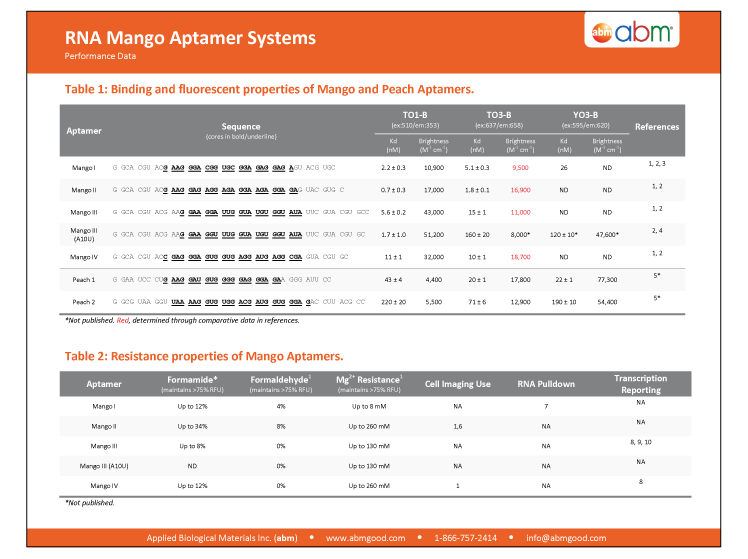
View data on binding affinity to Mango and Peach aptamers. 

The RNA Mango workflow

Follow the platform from aptamer tagging to RNA visualization or RNA–RNA and RNA–protein complex pull-down.

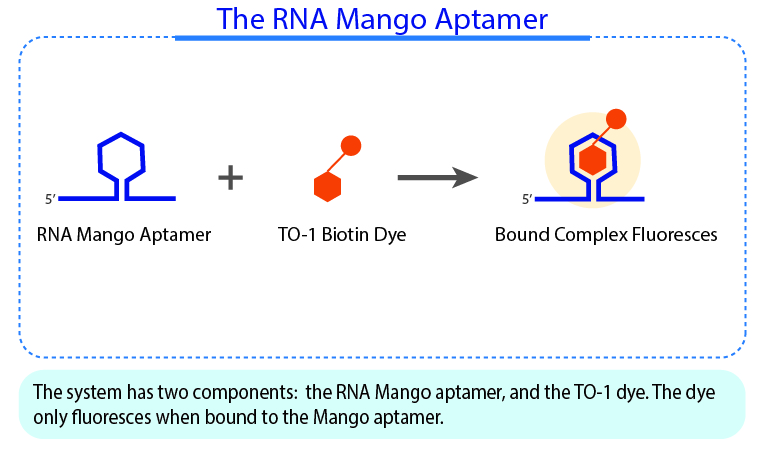
RNA Mango aptamer binding a TO1 dye that fluoresces after binding
01 | Assemble the system

The RNA Mango aptamer

The system has two components: the RNA Mango aptamer and the TO-1 dye. The dye only fluoresces when bound to the Mango aptamer.

Placement of an RNA Mango aptamer tag in an RNA target
02 | Tag the RNA

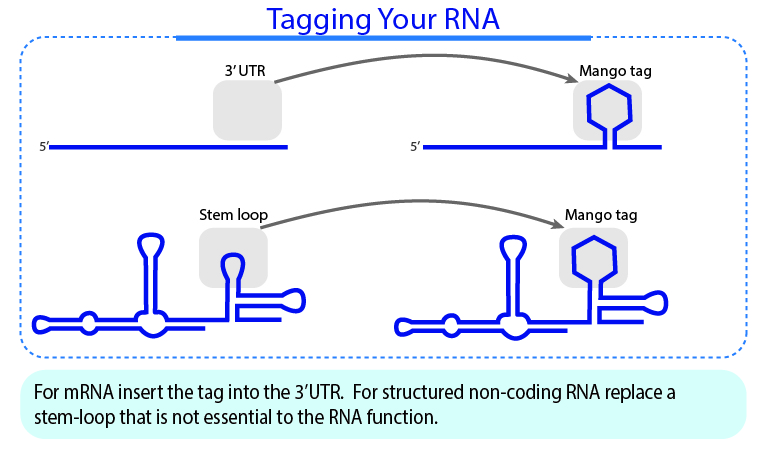
Tagging your RNA

For mRNA, insert the tag into the 3′ UTR. For structured non-coding RNA, replace a stem-loop that is not essential to the RNA function.

RNA Mango workflow for visualizing the localization of Mango-tagged RNA
03 | Image

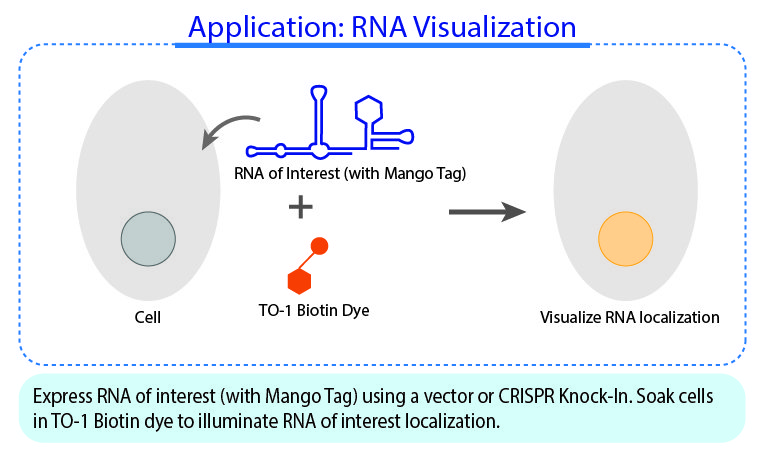
Application: RNA visualization

Express RNA of interest with a Mango tag using a vector or CRISPR knock-in. Soak cells in TO-1 Biotin dye to illuminate the localization of the RNA of interest.

RNA Mango pull-down workflow for recovering RNA–RNA or RNA–protein complexes
04 | Pull down

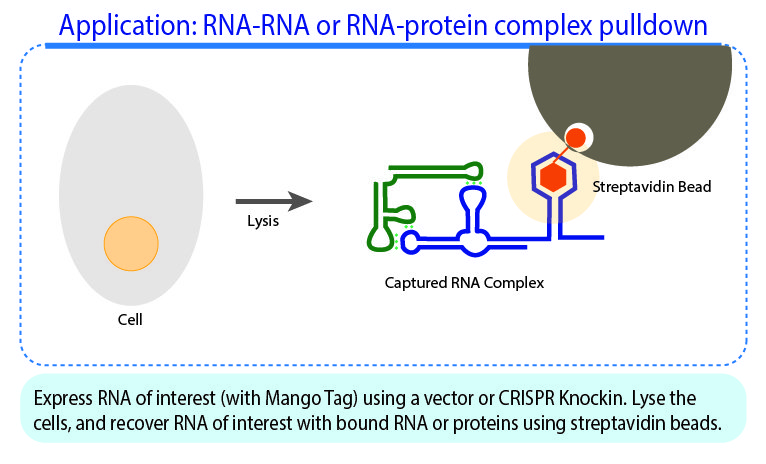
Application: RNA–RNA or RNA–protein complex pull-down

Express RNA of interest with a Mango tag using a vector or CRISPR knock-in. Lyse the cells, then recover the RNA of interest with bound RNA or proteins using streptavidin beads.

Laboratory results and performance data

Review examples of RNP purification, RNA Mango fluorescence, long-term signal stability, transcription monitoring, and two-colour RNA Mango/RNA Peach reporter assays.

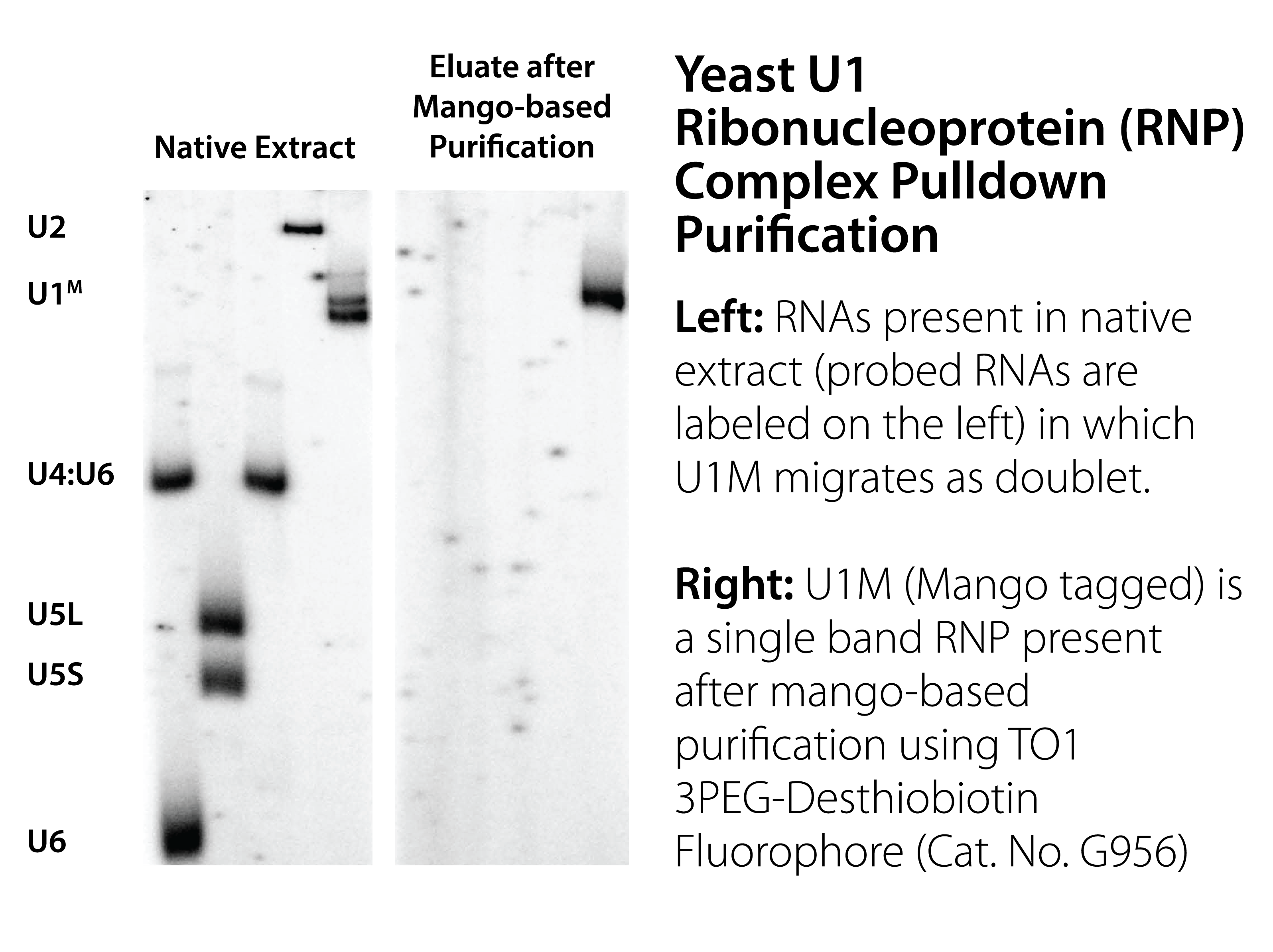
Yeast U1 ribonucleoprotein complex before and after RNA Mango pull-down purification
RNP pull-down purification

Yeast U1 ribonucleoprotein complex

Left: RNAs present in native extract in which U1M migrates as a doublet. Right: U1M is a single-band RNP present after Mango-based purification using TO1-3PEG-Desthiobiotin Fluorophore.

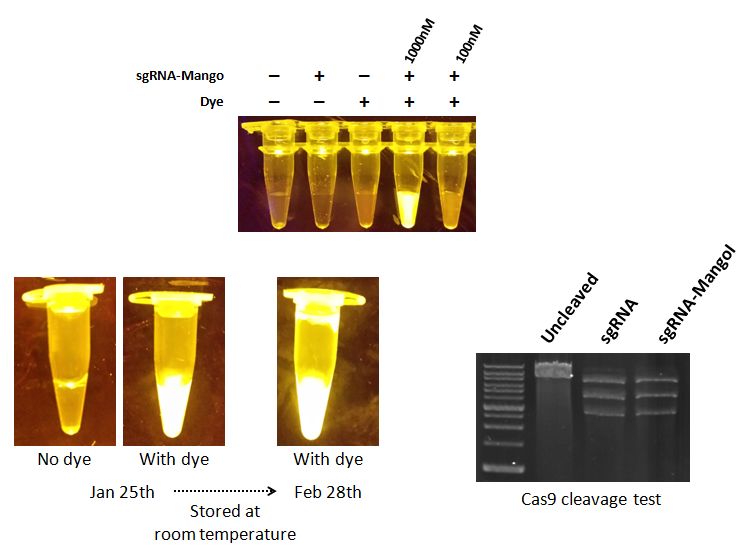
RNA Mango-tagged sgRNA fluorescing in a test tube
Fluorescence stability

RNA Mango in a test tube

Mango dye binding to in vitro transcribed RNA Mango-tagged sgRNA. Stable binding and fluorescence were observed even after leaving the tube for one month at room temperature.

Live transcription demonstration

RNA Mango in action

Samples were visualized in a blue-light box, and the movie is played back at 30× speed.

View complete transcription reaction conditions

Transcription reactions were carried out in 300 µL volumes using T7 RNA polymerase (400 U, 50 U/µL, applied biological materials), 0.5 µM TO1-3PEG-Biotin (applied biological materials), 8 mM GTP, 5 mM CTP and ATP, 2 mM UTP, 40 mM TRIS buffer pH 7.9, 2.5 mM spermidine, 26 mM MgCl2, 20 mM KCl, Pyrophosphatase (0.5 U, 0.1 U/µL, Thermo Fisher Scientific), and 0.01% Triton X-100. To each sample, either water (Negative), 0.33 µM DNA template (Mango Transcription), or 500 nM final Mango III A10U RNA (Positive) was added.

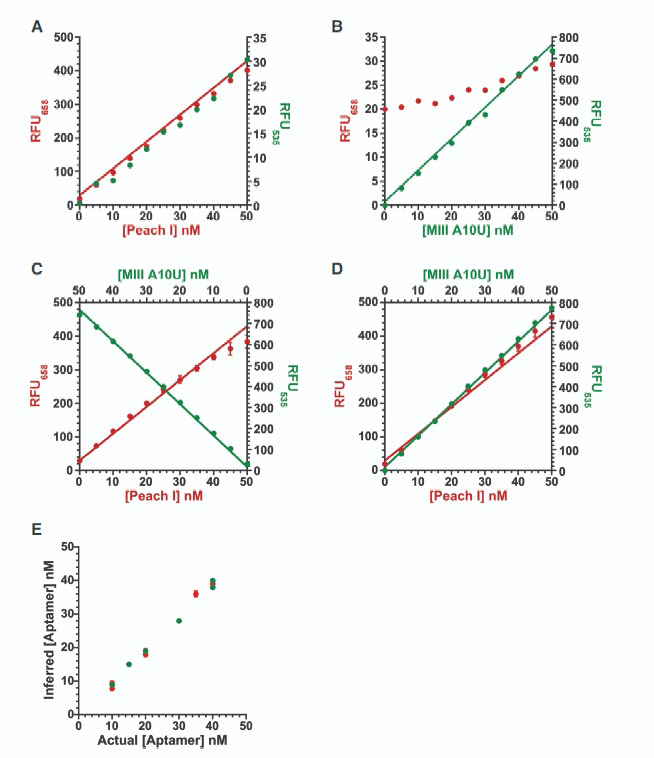
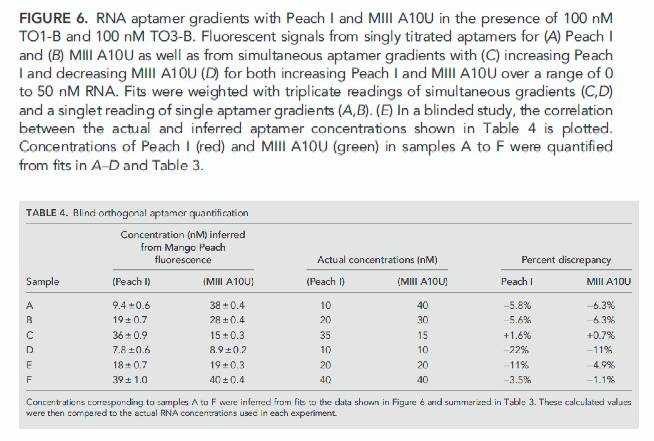
First panel of a TO1 and TO3 two-colour transcription reporter assay using RNA Mango and RNA Peach aptamers Second panel of a TO1 and TO3 two-colour transcription reporter assay using RNA Mango and RNA Peach aptamers
Two-colour reporter system

TO1 and TO3 with RNA Mango and RNA Peach aptamers

TO1 and TO3 dyes can be used in a two-colour reporter assay system using both the RNA Mango and RNA Peach aptamer systems (Kong et al. 2021).

RNA Mango documents and technical support

Use the original RNA Mango design and performance documents to plan aptamer placement, select dyes, and review reported binding, fluorescence, and resistance properties.

Design document

RNA Mango Insertion Guidelines

Guidance for placing the RNA Mango tag in mRNA and structured non-coding RNA targets.

Performance document

RNA Mango Binding, Fluorescence, and Resistance Properties

Performance information for RNA Mango aptamer systems, including supporting references.

Need a specific dye or experimental recommendation?

Browse the complete list of RNA Mango dyes, or speak with an abm technical support specialist at technical@abmgood.com.

Top RNA Mango publications

Primary literature describing RNA Mango-based ribonucleoprotein purification, high-affinity fluorophore binding, and aptamer complex stabilization.

01

Ribonucleoprotein purification and characterization using RNA Mango.

Panchapakesan SSS, Ferguson ML, Hayden EJ, Chen X, Hoskins AA, Unrau PJ, et al.
RNA. 2017 Oct;23(10):1592–1599.
DOI: 10.1261/rna.062166.117
PubMed: 28747322
PubMed Central PMCID: PMC5602116
02

Structural basis for high-affinity fluorophore binding and activation by RNA Mango.

Trachman RJ III, Demeshkina NA, Lau MWL, Panchapakesan SSS, Jeng SCY, Unrau PJ, Ferré-D’Amaré AR, et al.
Nature Chemical Biology. 2017 Jul;13(7):807–813. Epub 2017 May 29.
DOI: 10.1038/nchembio.2392
PubMed: 28553947
PubMed Central PMCID: PMC5550021
03

Fluorophore ligand binding and complex stabilization of the RNA Mango and RNA Spinach aptamers.

Jeng SC, Chan HH, Booy EP, McKenna SA, Unrau PJ, et al.
RNA. 2016 Dec;22(12):1884–1892. Epub 2016 Oct 24.
PubMed: 27777365
PubMed Central PMCID: PMC5113208

RNA Mango frequently asked questions

Concise answers to common questions about RNA Mango imaging, aptamer insertion, dye selection, and pull-down applications.

What is RNA Mango?
RNA Mango is a two-component RNA aptamer–fluorophore system. A Mango aptamer tag is inserted into an RNA of interest, where it binds a compatible Thiazole Orange dye and activates fluorescence.
How does RNA Mango fluorescence work?
The dye has low fluorescence when unbound and becomes strongly fluorescent after binding the Mango aptamer. The reported Mango–dye dissociation constant is approximately 3 nM, with fluorescence enhancement reported as FE = 1,100.
Where should the RNA Mango tag be inserted?
For mRNA, insert the tag into the 3′ UTR. For structured non-coding RNA, replace a stem-loop that is not essential to RNA function. See the RNA Mango Insertion Guidelines for more information.
Can RNA Mango be used for pull-down experiments?
Yes. After expressing Mango-tagged RNA and lysing the cells, the RNA of interest and its associated RNA or proteins can be recovered using streptavidin beads and a biotin- or desthiobiotin-linked fluorophore.
Which dye is the standard choice for RNA Mango experiments?
TO1-biotin is the standard variety of Thiazole Orange dye for RNA Mango experiments. Additional TO1, TO3, and YO3 fluorophores are available for different workflows.
Can RNA Mango and RNA Peach be used in the same reporter assay?
Yes. TO1 and TO3 dyes can be used in a two-colour reporter assay system with RNA Mango and RNA Peach aptamers, as described by Kong et al. (2021).

Need help planning an RNA Mango experiment?

Connect with abm technical support for guidance on fluorophore selection, aptamer placement, RNA visualization, or pull-down workflow planning.