

Recombinant Mouse IL7
| Cat. No. | Z200665 |
| Name | Recombinant Mouse IL7 |
| Description |
IL7 is a member of the hemopoietin family that plays a critical role in lymphocyte differentiation, proliferation, and survival. It is widely expressed by stromal epithelial cells in primary and secondary lymphoid tissues, including the thymus, bone marrow, and intestines. IL7 signals through a receptor complex composed of IL-7Rα and the common gamma chain, which is essential for both T and B cell lineage development. During B cell maturation, IL7 supports proliferation at specific developmental stages. In T cells, IL7 promotes the survival of naive and memory subsets by inducing expression of anti-apoptotic proteins such as Bcl-2. IL7 is also required for optimal T cell and dendritic cell interactions. Mouse IL7 shares approximately 88% amino acid identity with rat IL7, and 58–60% with human, bovine, equine, porcine, feline, ovine, and canine IL7. |
| Organism | Mouse (M. musculus) |
| Storage Condition | Upon receipt, store lyophilized protein at –70°C for long-term storage. Short-term storage at –20°C is acceptable if necessary. Once reconstituted, store at 2–8°C for up to 1 month, or at –20°C for up to 6 months. Avoid repeated freeze/thaw cycles. |
| Unit quantity | 10 µg |
| Family | Other Interleukins |
| Tag | C-6His |
| Aliases |
IL-7, interleukin-7, Lymphopoietin -1, PBGF, A630026I06Rik, hlb368 |
| Gene Symbol | IL7 |
| Gene ID | 16196 |
| Source | HEK293 Cells |
| Species | Mouse (M. musculus) |
| Appearance | Lyophilized Powder |
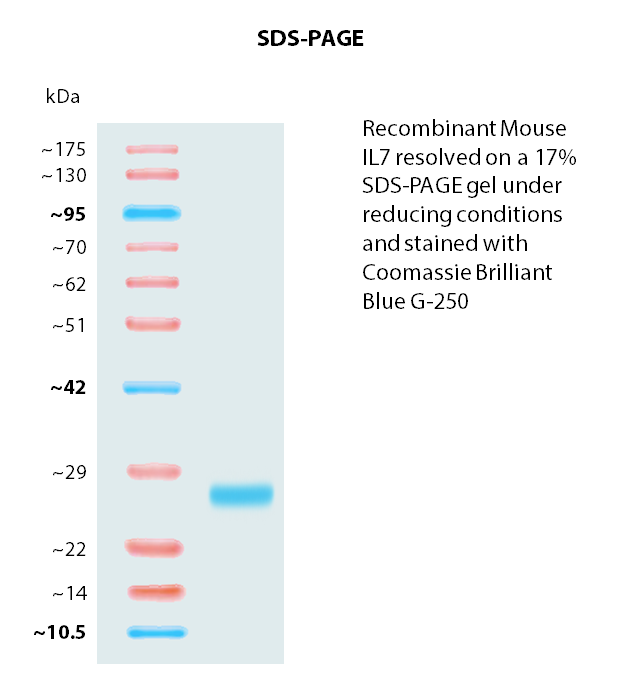
| Molecular Weight | 22-28 KDa, reducing conditions |
| Endotoxin Level | < 1 EU/µg as determined by LAL test. |
| Purity |
>95% as determined by SDS-PAGE |
| Formulation | Lyophilized from a 0.2 μm filtered solution of PBS, pH 7.4. |
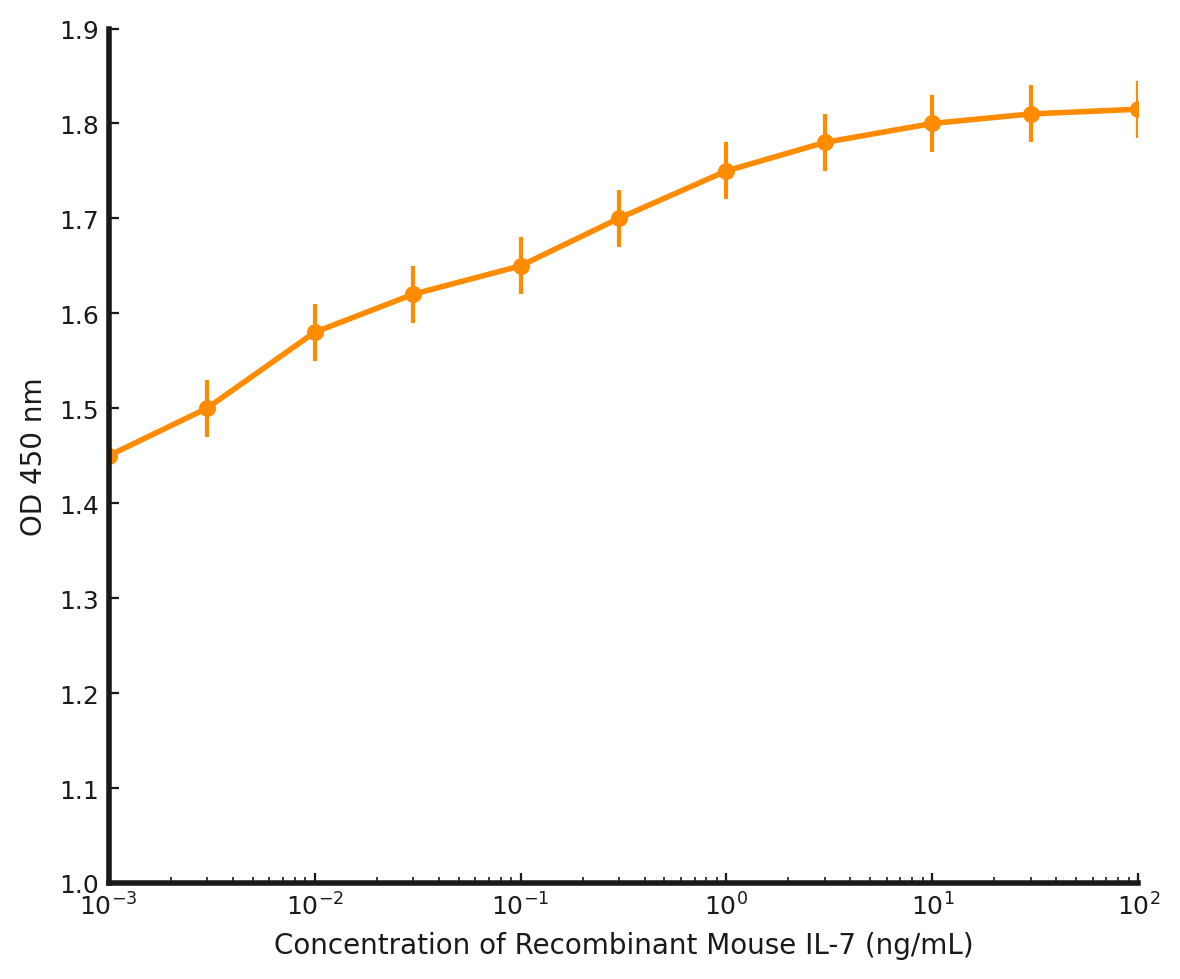
| Function | The ED50, as determined by the dose-dependent stimulation of PHA-activated human peripheral blood lymphocytes (PBL), is in the range of 0.06–1.0 ng/mL. |
| Reconstitution | A quick spin of the vial followed by reconstitution in sterile distilled water to a concentration not less than 0.1 mg/mL. This solution can then be diluted into other buffers. |
| Shipping Conditions | This lyophilized protein is shipped at ambient temperature. Cold packs may be used if transit temperatures are elevated. The product remains stable during normal shipping conditions. |
| Storage | Upon receipt, store lyophilized protein at –70°C for long-term storage. Short-term storage at –20°C is acceptable if necessary. Once reconstituted, store at 2–8°C for up to 1 month, or at –20°C for up to 6 months. Avoid repeated freeze/thaw cycles. |
| Usage | For research use only. Not for diagnostic or therapeutic use. |
| Material Citation | If use of this material results in a scientific publication, please cite the material in the following manner: Applied Biological Materials Inc, Cat. No. Z200665 |
| How do I choose the right growth factor for my experiment? | |
|
| What is the shelf life and storage condition of this product? | |
|
The lyophilized protein is stable for at least one year from date of receipt at -70°C. Upon reconstitution, this cytokine can be stored in working aliquots at 2° - 8°C for one month, or at -20°C for six months, with a carrier protein without detectable loss of activity. Avoid repeated freeze/thaw cycles.
|